


Fin Efficiency vs. Fin Effectiveness in Heat Exchanger Design
Fin Efficiency vs. Fin Effectiveness in Heat Exchanger Design
The optimization of heat transfer surfaces is a cornerstone of modern industrial thermal management. When designing or procuring finned tubes for heat exchangers, two metrics frequently surface: fin efficiency and fin effectiveness.
While they may sound synonymous to the uninitiated, these parameters represent distinct thermodynamic concepts that dictate the performance and cost-effectiveness of a heat exchange system. For engineers and B2B procurement specialists, understanding these nuances is essential to selecting the right tube configuration for specific operational environments.
The Core Concept of Fin Efficiency
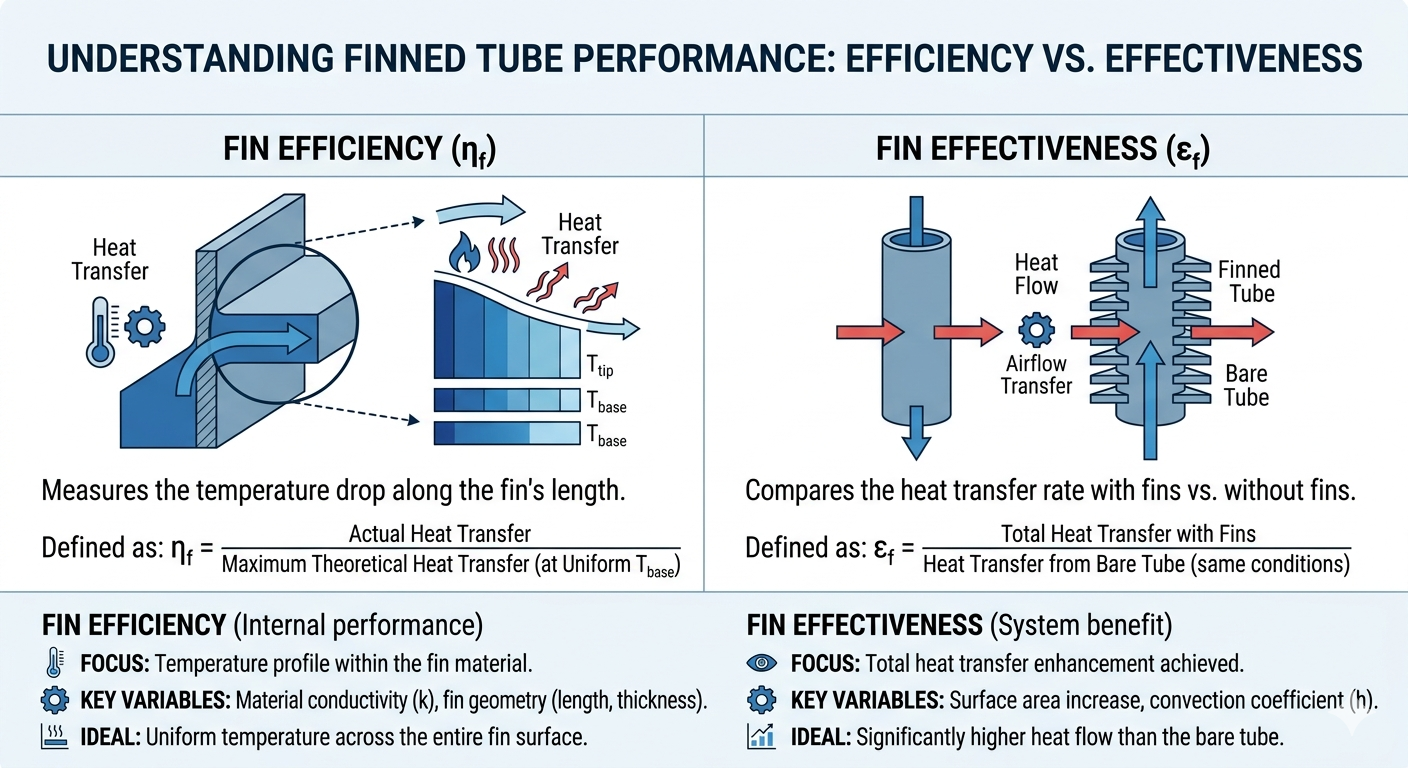
Fin efficiency is a measure of the thermal performance of an individual fin relative to an ideal scenario. It is defined as the ratio of the actual heat transfer rate from a fin to the heat transfer rate that would occur if the entire fin surface were maintained at the base temperature.
In a real-world application, as heat travels from the base tube through the fin, a temperature gradient is established. High fin efficiency indicates that the material and geometry are effectively conducting heat throughout the entire surface area.
- ✦ Material Thermal Conductivity
- ✦ Fin Thickness
- ✦ Fin Height
Defining Fin Effectiveness
While efficiency looks at the fin in isolation, fin effectiveness evaluates the impact of adding fins to a smooth surface. It is the ratio of the heat transfer rate with the fin to the heat transfer rate that would occur from the same base area without the fin.
"Is adding this fin actually worth it?"
An effective finned tube significantly enhances the total heat transfer rate. However, effectiveness is heavily influenced by the convection heat transfer coefficient of the surrounding fluid.
Practical Distinctions in Industrial Application
Understanding the trade-off between these two metrics is vital for custom production. A fin can be highly efficient (near 100%) but have low effectiveness if the increase in surface area doesn’t compensate for the added weight and cost.
Aluminum and copper offer superior conductivity, leading to higher fin efficiency even in taller profiles. Carbon or stainless steel require thinner or shorter fins to maintain acceptable efficiency levels.
Increasing fin density (FPI - Fins Per Inch) can increase effectiveness via surface area, but individual fin efficiency may decrease if airflow is restricted or boundary layers overlap.
In High Frequency Welded (HFW) or Extruded tubes, the bond is critical. Any gap acts as an insulator, plummeting both efficiency and effectiveness.
Customization Capabilities at Lord Fin Tube
We recognize that no two industrial applications are identical. Our manufacturing process focuses on optimizing the balance between thermal physics and mechanical durability across diverse sectors including petrochemical, power generation, and HVAC systems.
Extruded Finned Tubes
Ideal for maximum corrosion protection and high fin efficiency, as the fin and outer tube are a single integrated unit.
Footed Finned Tubes (L/LL/KL)
Optimized for moderate temperatures where cost-effectiveness and surface area maximization are primary goals.
HFW (Welded) Tubes
Designed for high-temperature and pressure environments, ensuring a robust metallurgical bond under extreme stress.
Expert Engineering Support
When selecting a partner for finned tube production, the technical expertise of the manufacturer is as important as the raw materials. Lord Fin Tube provides comprehensive engineering support to ensure that the chosen specifications—whether it involves serrated fins for increased turbulence or solid fins for easier cleaning—align with the calculated requirements for both efficiency and effectiveness.
By focusing on these technical benchmarks, we help our clients reduce energy consumption, minimize the footprint of their heat exchangers, and extend the service life of their equipment. Our commitment to quality control, from material sourcing to final pressure testing, ensures that every tube leaving our facility meets the highest international standards.