

Essential Quality Inspection Standards for Seamless Steel Pipes
Understanding Steel Pipe Integrity
How Quality Control and Manufacturing Prevent Failure
In high-pressure industrial environments, the integrity of seamless steel pipes is paramount to operational safety and efficiency. Whether used in oil and gas transportation, boiler systems, or as base tubes for high-efficiency finned tubes, the structural reliability dictates the longevity of the entire thermal system.
At Lord Fin Tube, we understand that quality assurance is the cornerstone of international trade. To help B2B buyers navigate the complexities of procurement, we have outlined the critical inspection protocols used to verify premium seamless steel pipe production.
Physical Dimensional and Surface Inspection
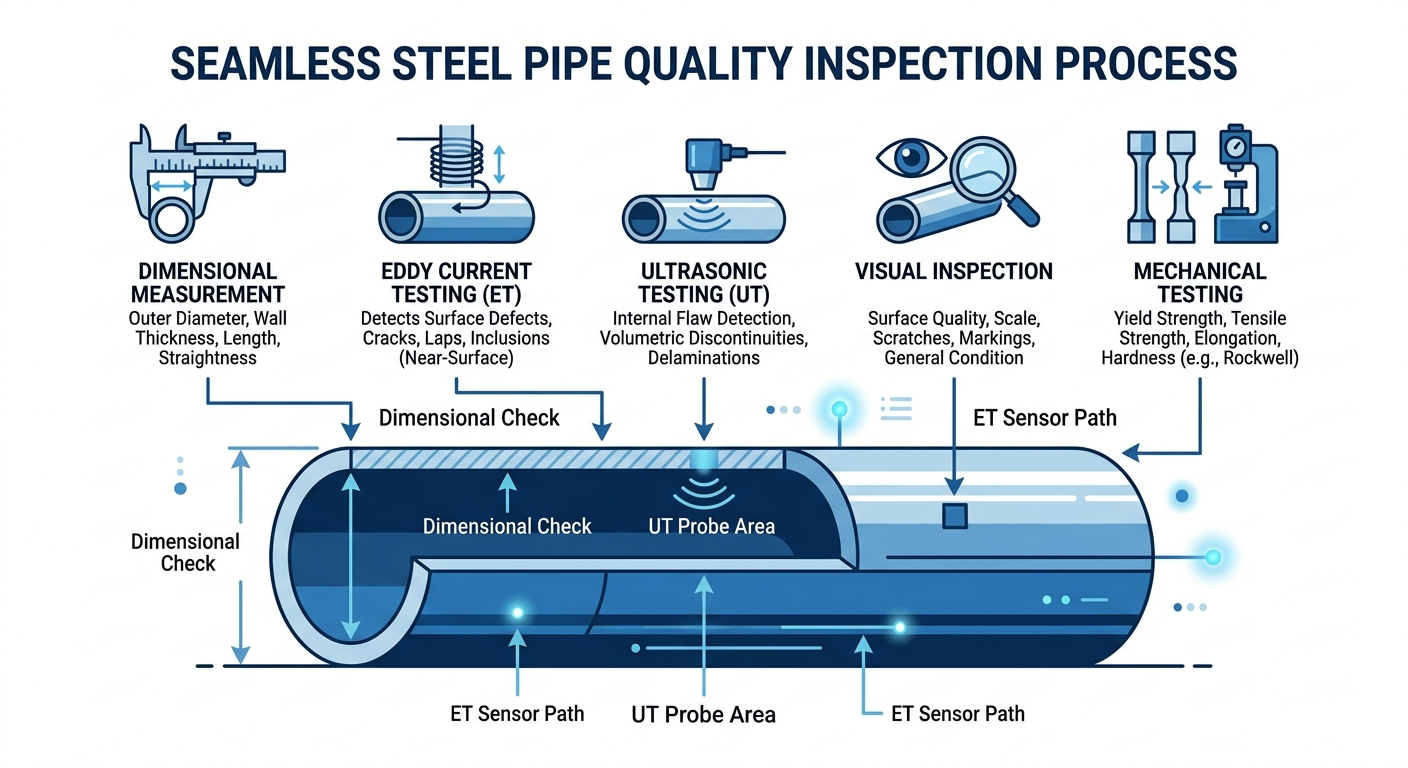
The first line of defense is a rigorous physical examination adhering to international standards such as ASTM A106, API 5L, or DIN specifications.
Chemical Composition and Mechanical Property Verification
The performance of a steel pipe is rooted in its molecular makeup. Every batch must match its Mill Test Certificate (MTC) heat number for full traceability.
Verifying levels of Carbon (C), Manganese (Mn), Phosphorus (P), and Sulfur (S). For specialized applications, Chromium (Cr) and Molybdenum (Mo) content must be precise to ensure corrosion resistance.
Tensile and Yield Strength: Destructive testing determines the maximum stress withstandable before rupture. Hardness Testing: Ensures correct heat treatment and durability.
Advanced Non-Destructive Testing (NDT)
For critical applications where internal flaws could remain hidden, NDT methods allow for 100% inspection without damaging the product.
Ultrasonic Testing: High-frequency sound waves identify internal inclusions, laminations, or cracks invisible to the naked eye.
Hydrostatic Testing: Pressurizing with water to a specific limit (often 1.5x working pressure) to guarantee leak-proof integrity.
Eddy Current Testing: Ideal for detecting surface and near-surface defects, ensuring the pipes skin is flawless before further processing.
The Synergy of Pipe Quality and Performance
At Lord Fin Tube, we emphasize that the quality of a finned tube starts with the base seamless pipe. If the base tube has inconsistencies, mechanical bonding or laser welding will be compromised.