


Lord Fin Tube-Tube Sheet Fabrication|Tube Sheet Manufacturing
Tube Sheet Fabrication: Technical Specifications and Manufacturing Processes
The precision of Tube Sheet fabrication critically influences the assembly, efficiency, and operational reliability of chemical processing equipment, boilers, and heat exchangers. The manufacturing parameters including tube hole spacing, diameter tolerances, perpendicularity, and surface finish directly impact thermal performance and structural integrity. With the ongoing expansion of chemical plants and power generation facilities, tube sheet dimensions have progressively increased, where diameters of 4-5 meters have become standard in industrial applications.
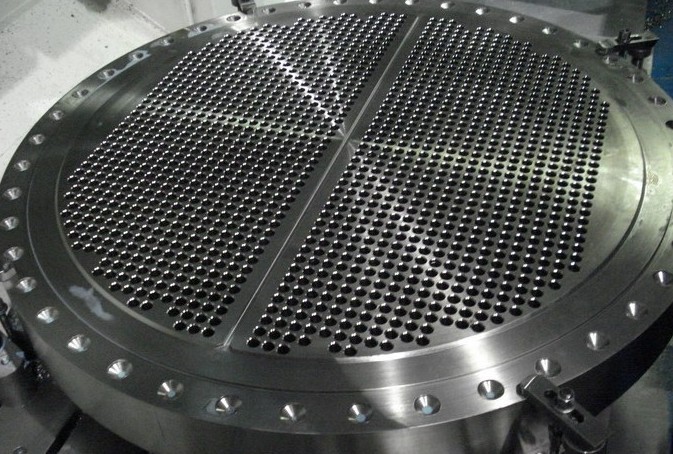
Tube Sheet Applications
Tube sheets serve as critical components across multiple industrial sectors including heat exchangers, boilers, pressure vessels, steam turbines, and large-scale HVAC systems. Specifically, Tube Sheet components provide structural support and secure positioning for tubes in various thermal processing equipment such as shell and tube heat exchangers, condensers, evaporators, and desalination units. The selection of appropriate metallic materials ensures not only mechanical strength and rigidity but also optimal thermal conductivity essential for efficient heat transfer operations.
Primary Industrial Applications:
- Shell and Tube Heat Exchangers
- Power Generation Boilers
- Chemical Processing Pressure Vessels
- Marine and Offshore Condensers
- Large-scale HVAC Evaporators and Condensers
- Desalination Plant Heat Recovery Systems
Tube Sheet Materials
Material selection for tube sheet fabrication depends on operational parameters including temperature, pressure, corrosive environment, and thermal expansion requirements. The table below outlines common materials and their respective applications:
| Material Type | Standards | Temperature Range | Primary Applications | Corrosion Resistance |
|---|---|---|---|---|
| Carbon Steel | ASTM A516, A285 | -20°C to 450°C | Boilers, Low-pressure Heat Exchangers | Moderate (requires coating) |
| Stainless Steel 304/316 | ASTM A240, A182 | -250°C to 800°C | Chemical Processing, Food Industry | Excellent |
| Duplex Stainless Steel | ASTM A790, A182 | -50°C to 300°C | Offshore, Desalination Plants | Superior (chloride environments) |
| Copper Alloys | ASTM B171, B152 | -150°C to 250°C | Marine Condensers, Heat Exchangers | Excellent (seawater) |
| Titanium | ASTM B265, B338 | -250°C to 600°C | Chemical, Power Generation, Marine | Outstanding (wide range) |
Tube Sheet Manufacturing
Material Preparation
Raw material selection and verification according to specifications. Cutting and shaping to required dimensions with ultrasonic testing for material integrity.
Drilling Operations
Precision drilling of tube holes using CNC machines with tolerances within ±0.05mm. Hole pattern accuracy maintained through coordinate measuring machines.
Surface Finishing
Machining of sealing surfaces to achieve required surface roughness. Application of protective coatings and corrosion-resistant treatments as specified.
| Manufacturing Parameter | Standard Tolerance | Precision Grade | Inspection Method |
|---|---|---|---|
| Tube Hole Diameter | ±0.075 mm | ±0.025 mm | Plug Gauges, CMM |
| Hole Spacing (Pitch) | ±0.1 mm | ±0.05 mm | Optical Comparators |
| Perpendicularity | 0.1 mm/100 mm | 0.05 mm/100 mm | Dial Indicators, CMM |
| Surface Finish | 3.2 μm Ra | 1.6 μm Ra | Surface Profilometer |
| Flatness | 0.5 mm/m | 0.2 mm/m | Precision Levels, Laser Trackers |
Tube Sheet Design
Engineering design of tube sheets involves complex calculations to determine optimal thickness, ligament efficiency, and tube pitch patterns. Factors including pressure differentials, thermal stresses, and corrosion allowances must be considered according to ASME Section VIII standards.
Design Considerations:
- Minimum ligament width between tube holes
- Thermal expansion differentials between tubes and sheet
- Corrosion allowance based on service environment
- Pass partition plate arrangement for multi-pass units
- Tube-to-sheet joint design (expanded, welded, or both)
- Nozzle and flange integration points
Tube Sheet Quality Control
Comprehensive quality assurance protocols ensure tube sheets meet exacting industry standards. Non-destructive testing methods including ultrasonic examination, liquid penetrant testing, and dimensional verification guarantee component integrity before installation.
Tube Sheet Fabrication Process Video
Video content would be embedded here demonstrating manufacturing processes