


What is Moisture Separator Reheater (MSR) Tube?
In the conventional island of a nuclear power plant, the Moisture Separator Reheater (MSR) is often an overlooked yet critical piece of equipment, undertaking the dual mission of drying and reheating. At the heart of the MSR is its reheater tube bundle. Thousands of heat exchange tubes operate long-term in a complex environment characterized by high temperature, high pressure, high humidity, and potentially trace impurities. Their material selection, structural design, and manufacturing quality directly determine the performance and service life of the equipment.
What is an MSR?
A Moisture Separator Reheater (MSR) is a key large component in the turbine system of nuclear power plants (especially Pressurized Water Reactor plants) and some large thermal power plants. It is used to increase the dryness and temperature of steam entering the low-pressure turbine, thereby enhancing the overall power generation efficiency of the unit and protecting turbine blades.
1. Why is an MSR Necessary?
In PWR nuclear power plants, the steam generated by the reactor is typically saturated steam (temperature around 260-280°C), unlike the superheated steam in thermal power plants. After this saturated steam performs work in the high-pressure turbine, its pressure and temperature drop, causing the steam to become wet and contain numerous water droplets.
Hazards of Wet Steam:
Erosion
Erodes blades, reducing their lifespan and safety.
Efficiency Loss
Reduces the relative internal efficiency of the turbine.
Thermal Stress
Causes thermal stress.
2. How Does an MSR Work?
An MSR is typically a large cylindrical vessel, and its operation is mainly divided into two stages:
Stage 1: Moisture Separation
Steam Enters the MSR: Steam that has performed work in the high-pressure turbine (high-pressure turbine exhaust) enters the MSR. At this point, the steam humidity can be as high as 10%-14%.
Process: The steam flows through special separation elements (such as corrugated plate separators or cyclone separators). Using centrifugal force, inertial impingement, and adhesion, larger water droplets are separated and collected at the bottom.
Result: After separation, the steam humidity is reduced to a very low level (typically below 0.5%), but the temperature remains at saturation temperature.
Stage 2: Reheating
Dried Saturated Steam Enters the Tube Bundle: The dried steam flows through dense heating tube bundles. These bundles contain a high-temperature heating source inside the tubes.
Heating Source: This usually comes from the main steam line (fresh high-temperature steam from the reactor) or extraction steam from the high-pressure turbine.
Result: The steam is heated into slightly superheated steam (typically with a superheat of ten to several tens of degrees Celsius).
3. Why is the MSR Important?
Efficiency Boost
Dry steam contains higher energy. Through reheating, the steam temperature increases, and its specific volume increases. Upon entering the low-pressure turbine, it can continue to expand and perform work, increasing the overall cycle thermal efficiency by about 2%-3%.
Equipment Protection
It greatly reduces the erosion of low-pressure turbine blades by wet steam, extending the turbines lifespan and reducing maintenance costs.
Reduced Blade Stress
Uniform superheated steam avoids the impact vibration caused by water droplets on the blades, resulting in smoother operation.
What are MSR Tubes?
The tubes used in an MSR primarily refer to the heat exchange tubes in the reheating stage. Due to the MSRs operating environment involving high-velocity steam, phase change, and thermal stress, the requirements for tube materials are extremely high.
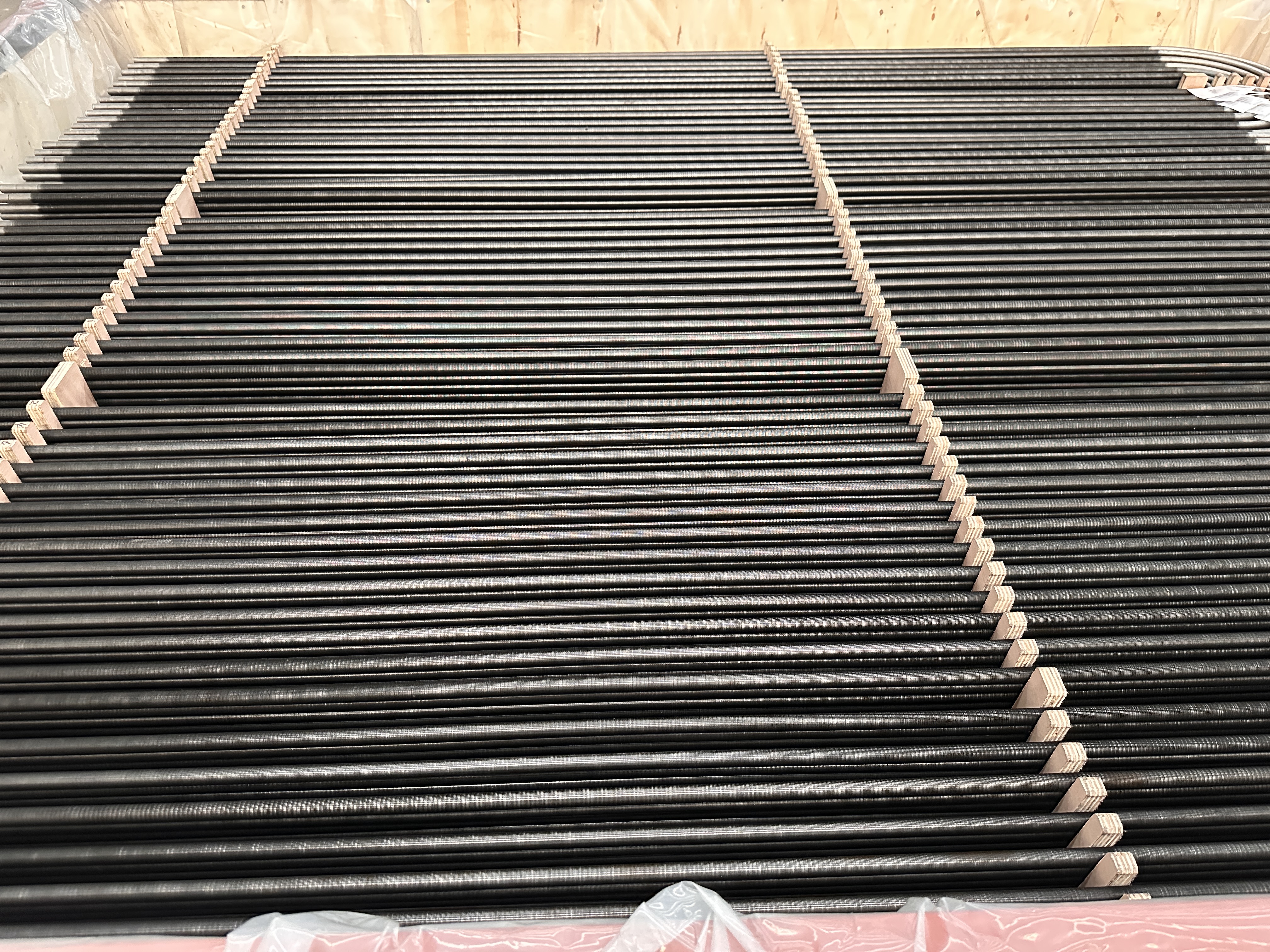
MSR tubes are typically not smooth straight tubes; they often use finned tubes to enhance heat transfer.
Form
Spiral fins are rolled onto the outer wall of the tube.
Function
Enhances Heat Transfer: Steam flows outside the tubes. The fins greatly increase the heat transfer area, making heating more efficient and reducing equipment size.
Aids Condensate Drainage: The heating steam condenses into water; the fins help drain condensate, reducing liquid film thickness.
The finned tubes used in MSRs are primarily low-fin tubes. Why?
Film Condensation
Shell side condensation thermal resistance is reduced by low fins thinning the liquid film. External surface area is 2.5–3 times that of a plain tube, boosting heat transfer.
Compactness & ΔP
Low fins pack more area within limited MSR volume. High fins could impede condensate drainage and cause flooding.
Vibration Resistance
Integrally rolled low fins have extremely high rigidity, resisting high-velocity steam冲击. High wrapped fins have contact resistance and may loosen.
Cleanliness & Drainage
Low, smooth fins allow condensate to flow easily, preventing accumulation and maintaining heat transfer.
Materials for MSR Tubes
TP439 ferritic stainless steel is the most widely used material for MSRs in PWR nuclear power plants.
| Property | Advantage |
|---|---|
| Stress Corrosion Resistance | Not sensitive to chloride-induced SCC, suitable for wet-dry interface conditions. |
| Thermal Expansion Matching | CTE close to shell material (carbon/low-alloy steel), lower thermal stress. |
| Economy | Lower cost compared to nickel-based alloys. |
The most typical tube configuration in nuclear plant MSRs is:
Material: TP439 Ferritic Stainless Steel
Form: Low-Fin Tubes
Arrangement: Typically
U-tube bundles
(allows for free thermal expansion of the tube bundle, reducing thermal stress).
— Complete technical overview of MSR tubes —