


Why Finned Tubes Outperform Bare Tubes in Heat Transfer Efficiency
Engineering Insight: The Science Behind Enhanced Heat Transfer in Finned Tubes
Advantages of Finned Tubes
In the realm of industrial thermal management, the selection of heat exchange components directly impacts the operational efficiency and energy consumption of a system. A recurring question among B2B procurement specialists and engineers is why finned tubes are consistently preferred over traditional bare tubes in high-performance environments. The answer lies in the fundamental principles of thermodynamics and the strategic expansion of surface area.
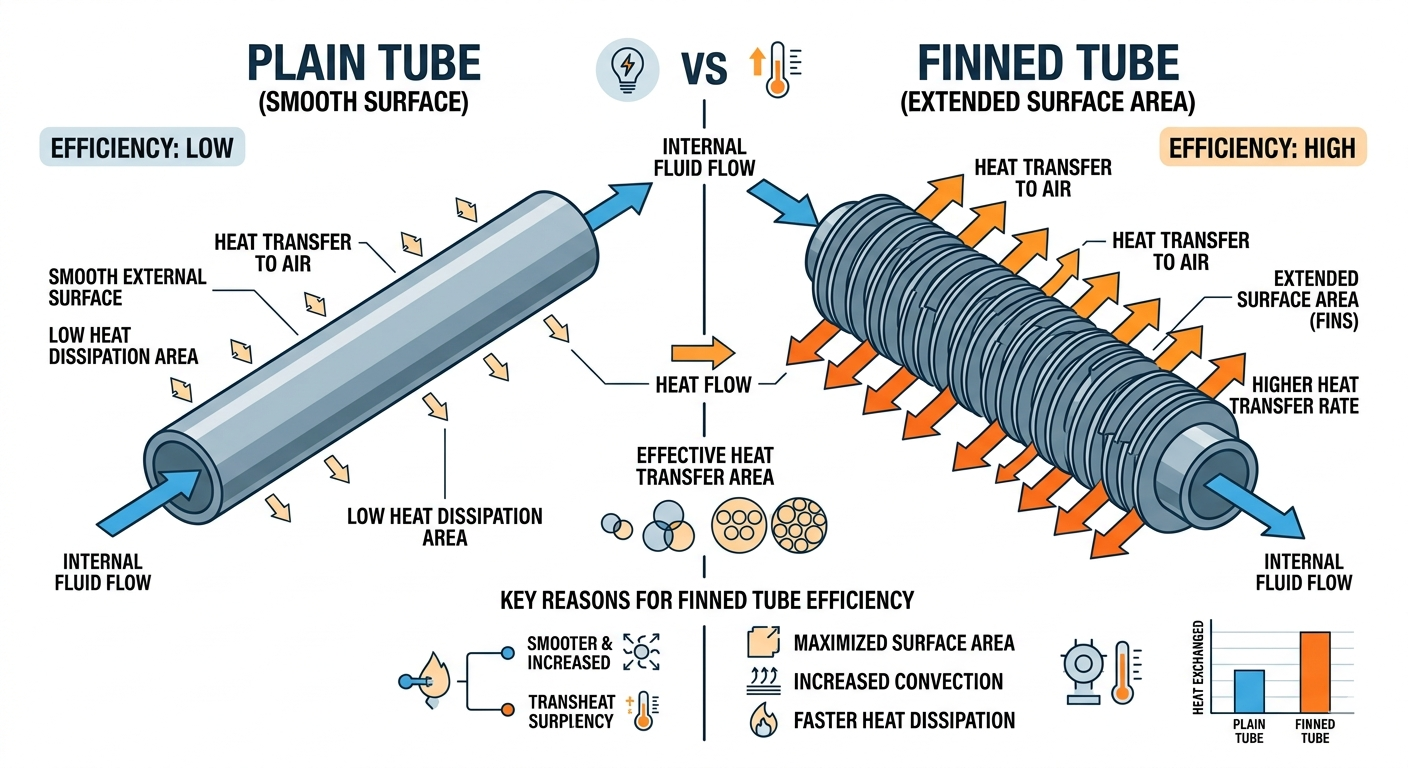
Expanding the Effective Heat Transfer Area
Standard Bare Tubes
Heat transfer is limited to the exterior surface of the pipe itself. Significant thermal resistance when dealing with fluids like air.
Integrated Finned Tubes
Surface area increases exponentially via high-frequency welding, extrusion, or tension winding. Provides "extended surface" for maximum dispersion.
This "extended surface" is crucial when dealing with fluids that have low heat transfer coefficients, such as air or gases. For instance, when hot fluid flows inside the tube and cold air passes over the outside, the air acts as a thermal insulator. The fins bridge this gap by capturing and dispersing heat into the air stream much more effectively than a smooth surface ever could.
Breaking the Boundary Layer with Turbulence
Efficiency is not merely about size; it is about the behavior of the fluid. In a bare tube setup, air often flows in a laminar (smooth) fashion, creating a "boundary layer" of stagnant air that clings to the tube surface and resists heat flow.
This turbulence constantly breaks the boundary layer, ensuring that fresh, cooler air (or secondary fluid) is always in contact with the heated metal surfaces. At Lord Fin Tube, we optimize fin density and height to balance this turbulence with pressure drop, ensuring maximum thermal gain without overstraining the system’s fans or pumps.
Material Synergy and Manufacturing Precision
The efficiency of a finned tube is also a product of its metallurgical integrity. The bond between the fin and the base tube must be seamless to prevent thermal resistance. Our production process at Lord Fin Tube focuses on high-integrity bonding techniques.
Application Scenarios: Where Finned Tubes Shine
Switching from bare tubes to finned tubes often allows for more compact equipment designs. Because each meter of finned tube does the work of multiple meters of bare tube, manufacturers can reduce the overall size of heat exchangers, leading to lower material costs and smaller installation footprints.
Handling high-pressure fluids and cooling volatile gases.
Optimizing economizers and waste heat recovery units (WHRU).
Improving the efficiency of large-scale air conditioning and refrigeration cycles.
By choosing specialized finned tube configurations from Lord Fin Tube, clients gain access to customized engineering that addresses specific fluid dynamics and temperature gradients. Our commitment to precision ensures that every component contributes to a more sustainable and cost-effective thermal operation.