


Lord Fin Tube--Spiral finned tube
What is Spiral Finned Tube?
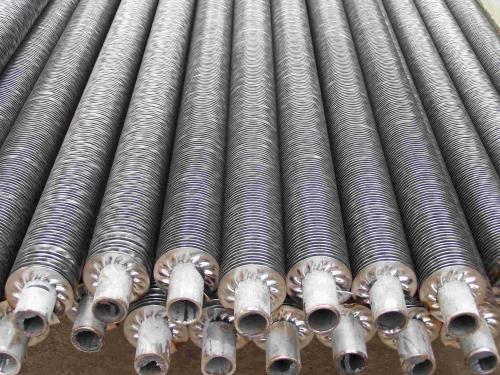
Spiral finned tubes represent a sophisticated heat transfer enhancement technology used extensively in industrial applications requiring efficient thermal exchange between fluids and gases. These specialized tubes feature continuous helical fins that are mechanically bonded, welded, or extruded from the base tube material, creating an expanded surface area that dramatically improves heat transfer efficiency.
Spiral Finned Tube Performance Metrics
Spiral finned tubes typically achieve heat transfer coefficients 3-8 times higher than equivalent smooth tubes, with surface area expansion ratios ranging from 5:1 to 20:1 depending on fin geometry and application requirements.
Material Compatibility
- Carbon Steel Tubes
- Stainless Steel (304, 316, 321)
- Copper & Copper Alloys
- Aluminum Fins
- Special Alloys (Inconel, Hastelloy)
Standard Dimensions
- Tube OD: 15mm - 100mm
- Fin Height: 6mm - 25mm
- Fin Thickness: 0.3mm - 2.0mm
- Fin Pitch: 2.5mm - 12.7mm
- Standard Lengths: Up to 12m
Advantages of Spiral Finned Tubes
Performance Enhancement Comparison
| Feature | Smooth Tube | Spiral Finned Tube | Improvement |
|---|---|---|---|
| Surface Area Ratio | 1:1 (Baseline) | 7:1 to 20:1 | 700% - 2000% |
| Heat Transfer Coefficient | 50-150 W/m²K | 150-450 W/m²K | 300% Increase |
| Space Requirement | 100% (Reference) | 30-50% | 50-70% Reduction |
| Material Efficiency | Standard | High | 40-60% Less Metal |
| Pressure Drop | Higher | Optimized | 30-50% Reduction |
Manufacturing Methods Comparison
| Method | Process Temperature | Bond Strength | Thermal Resistance | Applications | Cost Factor |
|---|---|---|---|---|---|
| High Frequency Welding | 1300-1400°C | Excellent | Very Low | High Pressure/Temperature | 1.2x |
| Brazing | 600-900°C | Good | Low | Corrosive Environments | 1.5x |
| Mechanical Winding | Ambient | Good | Medium | Low Pressure Applications | 1.0x |
| Extruded Integral | 800-1000°C | Excellent | Very Low | Abrasive Conditions | 2.0x |
Manufacturing Technical Specifications
High Frequency Welding: Power requirements: 50-400 kW, Frequency: 200-450 kHz, Weld strength: 95-100% of base material
Brazing Process: Filler metals: Silver, Copper, Nickel based, Joint clearance: 0.05-0.15mm, Atmosphere: Vacuum or controlled
Spiral Finned Tube Material
| Material Combination | Max Temperature | Corrosion Resistance | Thermal Conductivity | Cost Index | Recommended Applications |
|---|---|---|---|---|---|
| Carbon Steel + CS Fins | 450°C | Fair | 45 W/mK | 1.0 | Air Preheaters, Economizers |
| Stainless Steel 304 + Al Fins | 400°C | Excellent | 180 W/mK | 2.5 | Chemical Processing |
| Stainless Steel 316 + SS Fins | 800°C | Outstanding | 16 W/mK | 4.0 | High Temperature Recovery |
| Copper + Cu Fins | 200°C | Good | 400 W/mK | 3.0 | HVAC, Refrigeration |
Applications & Industry Usage
Power Generation
- Boiler Economizers
- Air Preheaters
- Feedwater Heaters
- Flue Gas Conditioning
Chemical & Process
- Reactor Cooling
- Process Heaters
- Waste Heat Recovery
- Distillation Columns
HVAC & Refrigeration
- Air Conditioning Coils
- Heat Recovery Wheels
- Chiller Bundles
- Dehumidification Systems
Performance Data by Application
Boiler Economizers: Typical efficiency improvement: 5-8%, Fuel savings: 3-6%, Payback period: 6-18 months
Air Preheaters: Combustion air temperature increase: 150-300°C, Boiler efficiency gain: 2-4%
Process Heaters: Thermal efficiency: 85-92%, Temperature range: -50°C to +800°C
Spiral Finned Tube Testing & Quality Standards
| Test Type | Standard | Pressure | Duration | Acceptance Criteria |
|---|---|---|---|---|
| Hydrostatic Test | ASME Section VIII | 1.5 x Design Pressure | 30 minutes | No leakage, No deformation |
| Pneumatic Test | ASTM A498 | 1.1 x Design Pressure | 15 minutes | No pressure drop |
| Fin Bond Test | HEI Standards | N/A | Visual & Torque | No movement at 10N·m |
| Thermal Cycling | Customer Specific | Operating Conditions | 100-1000 cycles | No fin separation |
Technical Consultation Available
Our engineering team can provide customized solutions for your specific heat transfer requirements. Contact us for technical data sheets, performance calculations, and application engineering support.
Spiral Finned Tube Design
Fluid Side Considerations
- Fouling Factors
- Velocity Limitations
- Pressure Drop Constraints
- Corrosion Allowance
- Thermal Expansion
Gas Side Considerations
- Fin Efficiency
- Dust Loading
- Erosion Protection
- Temperature Gradients
- Flow Distribution
Structural Considerations
- Vibration Analysis
- Support Spacing
- Thermal Stress
- Wind Loading
- Seismic Requirements
Spiral Finned Tube Advancements
Innovations in Spiral Finned Tube Technology
Enhanced Surface Designs: Latest developments include serrated fins, segmented fins, and proprietary surface enhancements that improve heat transfer coefficients by 15-25% compared to conventional spiral fins.
Advanced Materials: Development of composite fin materials and specialized coatings has extended service life in corrosive environments by 300-500%.
Digital Manufacturing: Implementation of Industry 4.0 technologies has improved dimensional accuracy to ±0.1mm and reduced manufacturing variations by 60%.
For specialized applications requiring custom spiral finned tubes, our engineering team can develop optimized solutions based on your specific operating conditions, fluid properties, and performance requirements.